How Are Rhinos Protected From Poachers?
- How are rhinos protected from poachers?
- Which part of the problem does each measure address?
- What do rangers and monitoring contribute?
- Why are reserves and fences not the whole answer?
- What does dehorning change?
- Why move rhinos if they still need protection afterward?
- How do investigations connect to field protection?
- Where do local communities fit?
- Can changing demand protect an animal far away?
- How can a reader recognize an honest protection claim?
- Frequently asked questions
- Sources
How are rhinos protected from poachers?
Rhinos are protected through a combination of trained field teams, monitoring, managed conservation areas, lawful investigations, community partnership and efforts to reduce demand for horn. Some programs also use veterinary-led dehorning or move animals to suitable, better-protected habitat. Each measure addresses a different part of the problem; none guarantees safety. Animal interventions belong to qualified teams, and public reporting should exclude precise animal locations and operational security details.
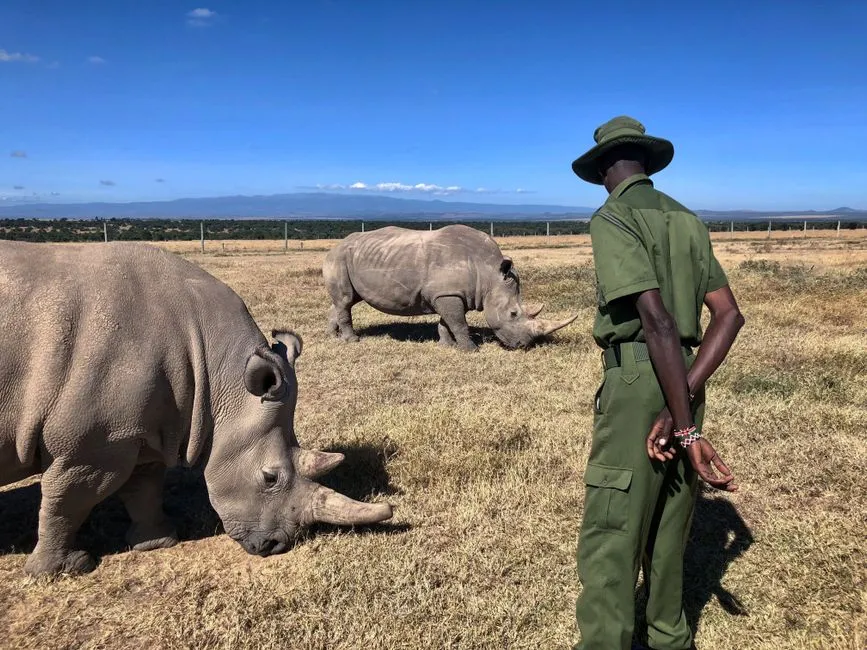
A photograph of a ranger or a hornless rhino shows one part of that work. Understanding protection means asking what happens around it: who interprets the monitoring, who supports the field staff, what follows an arrest, and how managers know whether losses are falling.
This is an explanation of those connections, not a guide to patrol tactics. For the broader picture, including habitat and population management, start with what rhino conservation does.
Which part of the problem does each measure address?
There is a useful distinction between preventing an immediate killing and changing the conditions that make poaching persist. Both matter, but they operate through different mechanisms.
IUCN's explanation of its African Rhinoceros Conservation Framework 2025–2035 separates safety and security from disrupting organized crime, understanding horn markets, ecological management, and equity and rights. That is a more helpful starting point than looking for one winning technology.
| Protection layer | Its intended contribution | What it cannot establish by itself |
|---|---|---|
| Rangers and monitoring | Observe animals and threats; support lawful protection decisions | That every animal is safe or every threat is detected |
| Managed areas and boundaries | Provide a place where habitat and access can be managed | That a reserve designation or fence eliminates crime |
| Dehorning | Reduce the incentive associated with an animal's horn | That the animal can no longer be poached |
| Translocation | Move animals for an assessed conservation benefit | That arrival proves long-term success |
| Investigations and justice | Address the people and networks involved in wildlife crime | That an arrest equals a completed prosecution |
| Community partnership | Include rights holders in decisions and benefits | That a meeting or donation proves equitable participation |
| Demand reduction | Change the motivations and behavior of horn consumers | That campaign exposure equals reduced purchasing |
The right question is not simply which row receives money. It is whether the program explains the connection between its chosen activity and the result it expects.
What do rangers and monitoring contribute?
Field protection depends on people with training, equipment and institutional support. Save the Rhino's protection program describes support ranging from ranger equipment and accommodation to veterinary work and animal-monitoring technology. Its examples also include salaries, rations and vehicle maintenance.
Those are different kinds of support, not interchangeable purchases. A monitoring tool supplies information; trained people must assess it and authorities must decide what action is lawful and appropriate. A donor should ask how equipment fits the team's work and how continuing costs will be covered.
Monitoring also gives managers evidence about the animals being protected. A public update can explain what was assessed and what decision followed without revealing an animal's current whereabouts.
Protection work can be dangerous. It should be conducted by authorized professionals under applicable law, with respect for human rights and staff welfare. Members of the public should not attempt patrols, approach suspected poachers or undertake wildlife interventions.
Why are reserves and fences not the whole answer?
A reserve is a managed place, not a promise that crime cannot occur there. Where fences are used, their physical presence should not be confused with proof that protection is effective. The public evaluation remains the same: what is being managed, who is responsible, and what evidence shows the intended benefit?
Consider a proposal to create a new protected area. Before treating the designation as a result, ask whether the plan addresses suitable habitat, lawful authority, staff, continuing finance and the people whose lives or land rights it affects. These are editorial assessment questions, not construction or security instructions.
The distinction matters because protected animals still need a viable place to live. IUCN's framework treats ecological management and the safety of both rhinos and people as connected responsibilities. Counting infrastructure alone leaves those responsibilities untested.
Do not request or circulate boundary vulnerabilities, access arrangements or security specifications to satisfy curiosity about a reserve. Public accountability can describe governance and outcomes without exposing how protection is organized.
What does dehorning change?
Dehorning is a specialist intervention intended to reduce the incentive to kill a rhino for its horn. It is not something visitors or volunteers should attempt. Wildlife veterinarians and authorized managers must assess the animal, welfare implications and local circumstances.
Save the Rhino's dehorning explainer notes that horn regrows, the procedure involves anesthesia risk, and rhinos use their horns in behavior including defense and foraging. It also describes continuing uncertainty about behavioral effects. Reducing poaching risk does not make welfare questions disappear.
There is meaningful evidence of benefit, but its scope matters. A study published in Science in 2025 examined 11 reserves in South Africa's Greater Kruger region from 2017 to 2023. The University of Cape Town's account of the research reports a 78% reduction in poaching associated with dehorning; the intervention involved 2,284 rhinos across eight reserves.
That percentage describes a study result, not an individual animal's guaranteed protection. The researchers compared populations and changes over time. They also identified continued poaching and the possibility that pressure could shift elsewhere. It would be wrong to turn the finding into a universal success rate across every rhino species and setting.
The practical conclusion for a reader is narrow: dehorning deserves serious consideration within a locally assessed protection strategy, not promotion as a complete solution.
Why move rhinos if they still need protection afterward?
A conservation translocation deliberately moves animals for a measurable conservation benefit. That purpose is central to the IUCN conservation translocation guidance overview, which emphasizes judging, planning and monitoring the intervention.
Moving a rhino can change its circumstances, but movement is itself demanding. The International Rhino Foundation describes translocation planning that considers health, genetics, social relationships and security at the receiving location. It also describes research into stress and physical condition during transport.
For an anti-poaching proposal, ask two separate questions:
- Why is the receiving situation expected to offer a conservation benefit?
- How will the team assess the animal's welfare and subsequent outcome?
A photograph at release answers neither question completely. The receiving program still needs protection and monitoring; a move does not remove the wider illegal trade. Veterinary and logistical decisions belong to qualified professionals, and public updates should not disclose transport schedules or sensitive destinations.
How do investigations connect to field protection?
The problem does not end at the point where a rhino is killed. Save the Rhino's stated conservation strategy includes preventing and prosecuting poaching and trafficking, improving coordination among conservation agencies, and supporting enforcement in consumer countries.
These goals explain why field protection and criminal-justice work are separate but connected. For a public report, an incident recorded, a suspect arrested and a completed prosecution are different outcomes. Treating all three as “crime stopped” conceals what remains to be done.
Our editorial test is to look for a clear account of institutional responsibility and lawful follow-through. A program need not publish investigative methods to explain its role, partners and reporting limits. Nor should fundraising copy encourage violence or present local residents collectively as suspects.
Where do local communities fit?
People living with rhinos are rights holders and decision-makers, not simply an audience for conservation messages. Save the Rhino's community work emphasizes community-led conservation and benefits for people living within or near rhino landscapes.
When assessing a protection program, ask who helped decide its priorities, whose concerns were heard, and how benefits and burdens are considered. A school visit, job announcement or consultation meeting can be a worthwhile activity without proving that those wider questions have been resolved.
Do not assume a program has achieved community support because it uses that phrase. Look for an explanation of participation and accountability. Equally, do not reduce local participation to its usefulness for security: people's rights matter independently of whether an initiative produces an immediate change in poaching.
Can changing demand protect an animal far away?
Demand reduction addresses the reasons people seek horn. It complements work around the animals rather than replacing it.
TRAFFIC's account of the Chi Initiative describes consumer research and targeted communications in Viet Nam, including work with influential business and civil-society partners. The lesson is specificity: understand a particular audience and motivation instead of blaming an entire country or culture.
Evaluation is essential. TRAFFIC's monitoring and evaluation guidance distinguishes campaign reach from effects on behavior and discusses checking reported change against more objectively verifiable evidence.
An advertisement being seen, a respondent stating an intention, and an actual change in purchasing are different observations. A credible claim says which was measured. None should automatically be translated into a precise number of rhinos saved.
How can a reader recognize an honest protection claim?
Look for the intervention, the measured result, the comparison and the limitations. “We supplied equipment” is an activity report. “Losses declined during the period” is an outcome report. Showing that a particular purchase caused the decline requires more evidence.
Ask whether the report identifies the species, broad setting and period without exposing sensitive information. Check whether it separates planned work from completed work and acknowledges setbacks. A program that explains uncertainty may be giving you more useful information than one offering an unqualified success story.
For financial and organizational checks, use the guide to donating to rhino conservation wisely. Here, the key lesson is about the protection claim itself: strong evidence is specific about what happened and careful about what follows from it.
Frequently asked questions
Does every rhino have a ranger beside it?
Do not interpret ranger support as a promise of a personal guard for each animal. Protection programs combine staff, monitoring and other measures according to their circumstances. Public descriptions should explain the purpose and results of that work without disclosing deployment patterns or individual animal locations.
Does removing a rhino's horn stop poaching completely?
No. Dehorning is intended to reduce the incentive for poaching, but killings can continue and horn regrows. It also involves welfare considerations and anesthesia risk. Decisions belong to qualified wildlife professionals, and dehorning does not remove the need for a wider protection strategy.
Why not rely on a fence?
A fence is not evidence that crime has been eliminated. Evaluate the wider management plan, including responsibility, suitable habitat, professional staffing, continuing resources and outcomes. Detailed security design belongs to the responsible authorities, not to public advice about how to build or test a barrier.
Is a relocated rhino automatically safer?
No. A proposed move needs an assessed conservation benefit, professional planning and welfare safeguards. The receiving situation and subsequent monitoring matter as much as arrival. Translocation can be useful without being risk-free, and a release photograph cannot establish the animal's long-term outcome.
What information should supporters avoid sharing?
Do not share precise or current rhino locations, transport arrangements, patrol patterns or protection vulnerabilities. Use public material approved by the responsible organization, and follow its visitor rules. If you encounter a suspected crime, contact the relevant authorities safely rather than investigating or confronting anyone yourself.
Sources
- IUCN: African rhino conservation framework overview
- Save the Rhino: Protecting rhinos
- Save the Rhino: Dehorning
- University of Cape Town: Dehorning research findings
- IUCN SSC: Conservation translocation guidance
- International Rhino Foundation: Translocation and rhino health
- Save the Rhino: Conservation strategy
- Save the Rhino: People and communities
- TRAFFIC: Rhino horn consumer behavior
- TRAFFIC: Demand-reduction evaluation guidance