What Rhino Conservation Actually Does
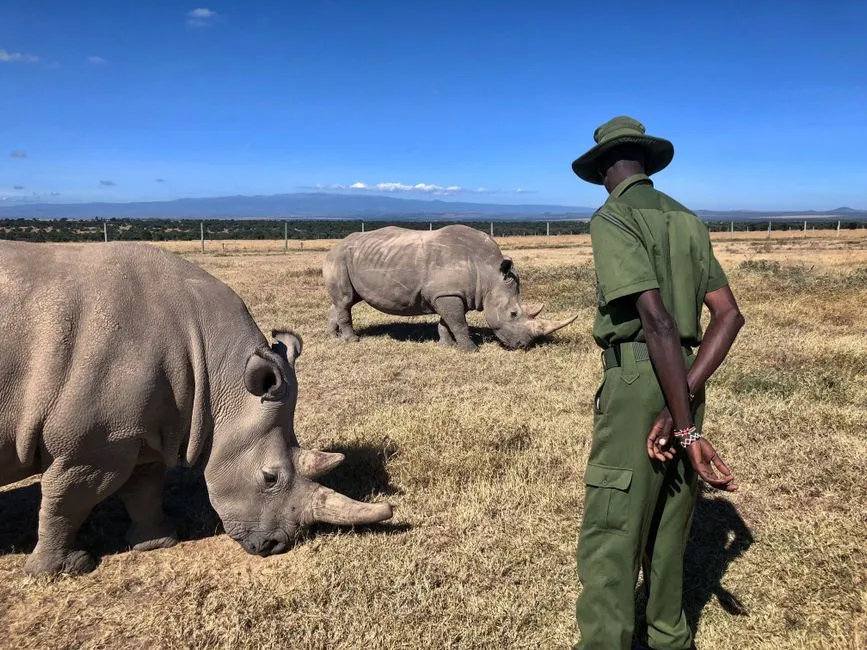
- Rhino conservation connects animals, habitat, and people
- Monitoring tells managers what decision is needed
- Protection extends beyond a patrol
- Habitat work keeps protection meaningful
- Biological management requires specialist judgment
- Community partnership is part of conservation design
- Funding should support the unglamorous chain
- Awareness is useful when it improves action
Rhino conservation connects animals, habitat, and people
Rhino conservation protects and manages viable wild populations by combining species monitoring, habitat and water management, trained field protection, veterinary and biological expertise, investigation of illegal trade, policy, community partnership, and long-term finance. The mix changes by rhino species, country, landscape, ownership, threat, and local priorities. No single intervention can carry the whole animal.
IUCN's African Rhino Specialist Group describes its mission as supporting viable populations in the wild through protection, biological management, research, reporting, communication, capacity, sustainable finance, and governance. IUCN Save Our Species similarly frames durable conservation around species, habitat, and people. Those categories are useful because a fence, patrol, or translocation makes sense only inside a larger system.
Monitoring tells managers what decision is needed
Teams may identify individual animals, document births and deaths, assess health and reproduction, map habitat use, and track threats. Methods can include direct observation, spoor, camera traps, aerial work, genetic information, remote sensing, and other tools selected for the landscape and question.
Data quality matters. A count is not automatically comparable with last year's count if survey area, detection, effort, or method changed. Responsible public reports explain uncertainty and avoid exposing real-time locations, patrol patterns, or technical vulnerabilities. A beautifully precise coordinate is not transparency when it can endanger an animal.
Monitoring supports decisions: whether habitat can sustain more animals, whether a population is becoming isolated, whether disease or injury needs investigation, or whether protection and community work should change. It also helps specialists assess status. The IUCN African Rhino Specialist Group collates information and advises across African range states.
Protection extends beyond a patrol
Field protection can include trained rangers, lawful intelligence, communications, access control, incident response, staff support, evidence handling, and coordination among wildlife authorities, police, customs, prosecutors, land managers, and communities. Effective programs operate under law and human-rights standards.
International wildlife trade is regulated through CITES and domestic law. The official CITES Trade Database contains trade records reported by Parties, but CITES advises users to read its interpretation guidance because the data are complex. Legal records and seizure information are not simple counters of illegal activity; reporting effort and enforcement also shape what appears.
Public education should never publish tactical patrol details or glorify violence. Rangers and investigators are professionals working inside institutions, not action-film characters supplied for fundraising copy.
Habitat work keeps protection meaningful
Rhinos need suitable connected habitat, food, water, space, and management responsive to drought, fire, invasive species, livestock pressures, infrastructure, and other landscape conditions. The exact ecology differs among species and sites. Habitat teams may restore areas, manage water carefully, maintain corridors, reduce conflict, and plan land use with neighbors and authorities.
Protecting an individual while its habitat shrinks is emergency care without a discharge plan. Conversely, habitat work that ignores current poaching or governance threats may leave animals exposed. Conservation programs must fit these efforts together.
More method explainers live in Field Explained.
Biological management requires specialist judgment
Small, isolated, crowded, or unevenly structured populations may require careful management. Qualified authorities and wildlife professionals can consider translocation, veterinary intervention, genetic goals, reproductive information, and population distribution. These decisions carry capture, transport, welfare, disease, social, legal, and ecological risks.
Do not treat a dramatic intervention as automatically good because it photographs well. Ask who authorized it, what evidence supports it, how animal welfare is protected, how the receiving habitat was assessed, and how outcomes will be monitored. Detailed operational choices belong to qualified teams, not internet volunteers with a map and a tranquilizer opinion.
Community partnership is part of conservation design
People live with the costs, rules, risks, opportunities, and benefits created by conservation areas. Durable programs engage legitimate local institutions and rights holders in decisions, grievance mechanisms, jobs, enterprise, land use, safety, and benefit sharing. “Awareness” is not a substitute for listening or fair governance.
IUCN's species conservation action overview emphasizes networks involving government agencies, scientists, nongovernmental organizations, and local communities. Results depend on context: a model cannot simply be copied from one country to another and declared community-led in the caption.
Funding should support the unglamorous chain
Conservation needs predictable finance for salaries, training, maintenance, data systems, fuel, insurance, audits, veterinary readiness, partner grants, and evaluation as well as visible equipment. Short emergency funding can help, but long-term biological and institutional work does not operate on viral attention alone.
The guide to donating to rhino conservation wisely shows how to assess legal identity, program logic, reporting, governance, restrictions, and payment security.
Awareness is useful when it improves action
Share claims with a source and date. Avoid stale global counts, graphic spectacle, simplistic blame, miracle technologies, and location details. Explain which species and place a claim concerns; “the rhino” collapses distinct conservation realities into one mascot.
Good awareness creates better questions: What threat is this program addressing? Who holds authority? How are local people involved? What will be measured? What could go wrong? That may feel less cinematic than “save them now.” It is also much closer to how conservation keeps working after the camera leaves.