Why Are Rhinos Poached? Understanding Demand for Horn
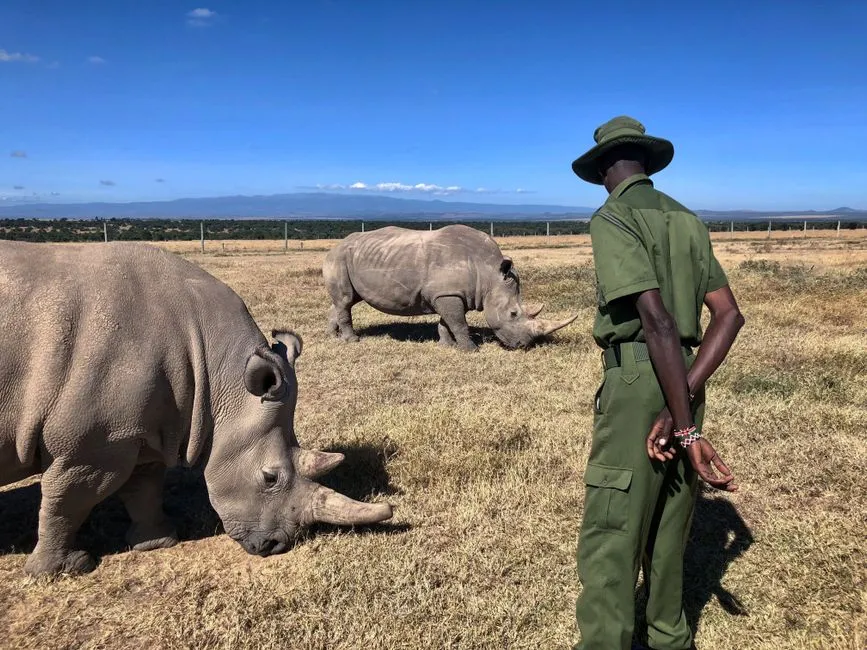
- Why are rhinos poached?
- What is rhino horn actually made of?
- What do buyers believe horn can do?
- How can health beliefs and luxury demand differ?
- Why does gift giving matter?
- Who connects demand to poaching?
- Why can the trade persist despite enforcement?
- Why is demand reduction part of conservation?
- What should a concerned reader take from this?
- Sources
Why are rhinos poached?
Rhinos are poached for their horns because buyers seek them for supposed health benefits, displays of wealth and gifts, creating opportunities for criminal profit. These motives can overlap, but they are not identical. Understanding the trade means examining both consumer beliefs and the networks supplying horn. Claims about medicinal use do not establish a treatment benefit; health concerns belong with qualified healthcare professionals.
A photograph of a killed rhino shows the loss. Explaining why that loss happens requires looking beyond the person who killed the animal. A buyer's expectation, a gift's social meaning and a trafficker's financial incentive are different parts of the same problem.
What is rhino horn actually made of?
Rhino horn consists primarily of keratin, a protein also present in human hair and fingernails. That comparison describes its material; it does not mean the horn is a bundle of compressed hair.
Save the Rhino's material explainer describes horn developing from specialized skin cells that become hardened through keratinization. The resulting structure is solid.
Keep the biological question separate from the market question. Knowing what an object contains does not, by itself, explain why someone considers it desirable. For that, conservation researchers have to ask people about their beliefs and purchasing decisions.
What do buyers believe horn can do?
The International Rhino Foundation describes demand involving purported remedies and the purchase of carved horn to demonstrate wealth. It states that scientific evidence does not support medicinal value.
Those are descriptions of demand, not endorsements of the claims attached to horn. Do not use rhino horn as a remedy or delay medical care because a seller, friend or online post recommends it. A qualified healthcare professional is the appropriate person to discuss symptoms and treatment.
It is also misleading to explain every purchase through a single sensational story. Someone seeking a supposed remedy and someone seeking an impressive possession need not expect the same thing from it.
How can health beliefs and luxury demand differ?
A 2016 NRDC consumer study announcement, reporting research in five Chinese cities, distinguished medicinal and luxury-goods markets. It found differences in how potential users and buyers behaved, including regional variation.
That is a dated research example, not a measurement of today's national demand. Its useful lesson is the need to distinguish motivations before deciding what an intervention should address.
The following questions illustrate that distinction; they are an editorial framework, not a classification of every buyer.
| Possible motive | Question a demand-reduction team needs to answer |
|---|---|
| Expected health benefit | What claim does the person believe, and whom do they trust? |
| Personal status | What recognition does the person expect ownership to bring? |
| Gift giving | What does the giver hope the recipient will understand? |
These questions help avoid a common mistake: giving an accurate answer to a question the intended audience was not asking.
Why does gift giving matter?
In its account of a 2018 study of rhino, elephant and pangolin product consumers in Viet Nam, TRAFFIC reported gift giving as the main purchasing reason. The research combined focus groups with telephone interviews involving 1,400 respondents across five cities.
This was a multi-species survey in a particular setting. It should not be turned into a claim that every horn purchase, or every Vietnamese consumer, follows the same pattern.
Gift giving matters analytically because the person making a purchase and the person receiving the product are not necessarily the same. Our reading is that an explanation focused only on personal consumption can therefore miss part of the transaction. A useful campaign question is what someone could give instead that expresses consideration without involving threatened wildlife.
Who connects demand to poaching?
Save the Rhino's account of poaching for horn describes criminal networks spanning borders, with different participants involved in killing animals, moving horns and finding buyers. It identifies China and Viet Nam as important demand markets.
This does not justify treating a country or culture as a single consumer. Nor should people living near rhino populations be treated as interchangeable with organized criminals. The relevant question is who participates in a particular illegal activity, supported by evidence.
For readers, separating roles prevents a misleading shortcut: the person buying an item need not be the person organizing its supply. Explaining the trade requires attention to both ends and the connections between them.
Why can the trade persist despite enforcement?
The Wildlife Justice Commission's 2024 assessment describes profit-driven transnational crime and corruption that enables trafficking. Its account includes convictions for wildlife trafficking, criminal association and money laundering.
Enforcement also has to address those who organize, finance or facilitate the trade. This is an institutional task requiring lawful investigation, not a role for visitors or amateur investigators.
The same assessment warns that falling reported seizures can be difficult to interpret. Horn may escape detection, seizures may go unreported, or stockpiling may be involved. These are alternative explanations, not proof of which explanation applies.
Consequently, a headline about fewer confiscations cannot, on its own, answer whether demand has fallen. Ask what was measured before accepting the conclusion attached to it.
Why is demand reduction part of conservation?
Demand reduction aims to change the reasons people want a product. TRAFFIC's account of its rhino-horn work describes developing messages around researched consumer motivations. Its Chi initiative in Viet Nam associates success with a person's own effort rather than possession of illegal wildlife products.
The example shows why a campaign may address identity and social expectations alongside correcting misinformation. A message about biological composition answers what horn is made of; it does not necessarily answer why someone wants to present it as an impressive gift.
Demand work belongs alongside protection and enforcement. Our guide to how rhinos are protected explains those complementary functions. No single message should be presented as a guarantee that a particular animal will survive.
What should a concerned reader take from this?
The useful conclusion is specific: horn demand has several motives, and criminal profit connects that demand to illegal killing. A clear explanation should identify which motive it is discussing, distinguish research findings from assumptions and state the limits of its evidence.
When sharing an article or conservation appeal, check whether it does those things. Avoid repeating unsupported market prices or treating a dramatic statistic as current when its date is missing. You can explain the seriousness of poaching without adding an unverifiable number.
If you want to support conservation, start with how to assess a donation. For the wider context beyond horn demand, read what rhino conservation does. Understanding the cause should lead to informed support for accountable work.
Sources
- Save the Rhino: What is rhino horn made of?
- International Rhino Foundation: The Rhino Crisis
- NRDC: Consumer demand study, 2016
- TRAFFIC: Consumer demand study, 2018
- Save the Rhino: Poaching for rhino horn
- Wildlife Justice Commission: Rhino horn trafficking assessment, 2024
- TRAFFIC: Rhino horn demand and behavioral change